Why Roofs Give a Stand Its Own Sound
How stadium roof shape affects crowd sound, and what to listen for to understand why the same chant feels different from stand to stand.

A stadium roof changes how crowd sound reaches a listener, and the difference is easiest to notice by comparing stands during the same match. A low canopy may return some voices towards the seating below it; a more open stand lets sound disperse upwards and outwards. Neither arrangement dictates atmosphere. The roof is one part of an acoustic setting that also includes the crowd, the pitch, surrounding stands and the listener’s position.
To understand why roofs give a stand its own sound, listen in a deliberate order: establish what is making the noise, notice the roof’s shape, then compare what you hear from different positions. This is not a technical survey. It is a way to distinguish a loud moment from the particular character of a stand.
Start with the sound
Before judging the roof, identify the sounds in the mix. A chant has a more sustained rhythm than applause, while a sudden reaction to play rises and falls quickly. Announcements, music and noise from neighbouring sections can also reach your seat, sometimes with different clarity.
Listen for whether a sound seems to come directly from nearby supporters, from across the ground, or from above and around you. A nearby voice usually has a clear direction. Reflected sound can seem less local, especially when several sections are making noise at once. That impression is useful, but it does not reveal a roof’s precise acoustic performance.
Choose one sound to follow through a passage of play. A repeated chant is convenient because its rhythm gives you time to notice changes. Avoid comparing a quiet pause in one section with a goal celebration elsewhere; the crowd’s behaviour would overwhelm any useful comparison.
Read the roofline
Look at the canopy from your seat without trying to infer too much from its appearance. Note whether it covers the seating, how far it extends over the crowd, and whether its underside looks continuous or broken up by beams, openings or changes in level. These features affect the paths sound can take, but appearance alone cannot tell you exactly what you will hear.
A roof can reflect some sound back towards the stand, rather than allowing it to travel freely into open air. The result may be a stronger sense of sound around the seating, especially when the canopy and nearby surfaces enclose the space. Reflections can also overlap with direct sound, making a chant feel fuller or less sharply located.
Open edges matter as well. A canopy that shelters seats but leaves the sides and rear exposed does not enclose the crowd in the same way as a more continuous structure. Sound can escape through those openings, while wind and noise from outside the stand can alter what reaches a listener.
Surface materials and internal geometry contribute too. A hard underside may reflect more sound than a surface that absorbs it, while projecting elements can scatter reflections. Those details are often difficult to assess from the seats, so treat them as possible influences rather than a reliable recipe for a particular atmosphere.
Compare positions carefully
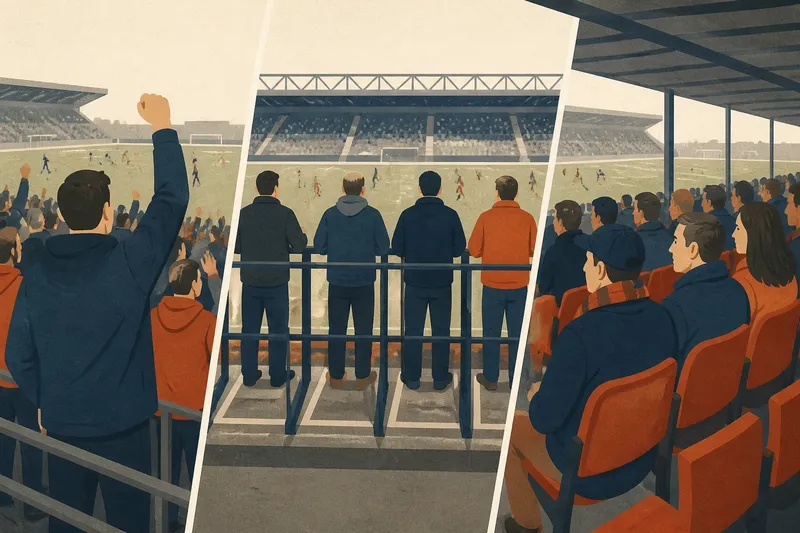
If you can move between public areas during a visit, compare the same sound from more than one position. A seat beneath the canopy, an exposed aisle or concourse, and a place with a view across the ground offer different listening conditions. Do not enter restricted areas or move during play in a way that obstructs other supporters.
Keep the comparison modest. Listen for whether the chant seems more direct, more diffuse or more enveloping, and whether you can still pick out individual voices. The change may come from distance, crowd density, barriers or the direction of the loudest section rather than the roof itself.
Say you are seated beneath a broad canopy and hear a chant clearly from the stand opposite, while the nearby section is quiet. If you later pause in an open concourse and the chant seems less contained, the expected observation is a change in how much surrounding sound you perceive, not proof that the canopy alone caused it. The crowd’s position and the concourse’s own surfaces remain part of the comparison.
Where possible, compare similar moments on different visits. The same stand may sound subdued when supporters are listening closely to play and more enveloping during a sustained song. A roof does not supply the missing voices; it shapes the conditions in which present voices are heard.
Why does a roof change crowd sound?
Does a low roof make a stand louder?
A low canopy may return more sound towards the seating than a high, open roof, which can make the crowd feel more enclosed. But perceived loudness also depends on the number and location of voices, the stand’s openings and where you are listening.
Why can a chant sound blurred?
Direct voices and reflections may arrive together, while supporters in different sections sing at slightly different times. Distance, background noise and the shape of the space can further soften the rhythm or make individual words harder to distinguish.
Does an open stand always sound quieter?
No. An open stand may lose some reflected sound, yet a large, vocal crowd can still produce a strong impression. The pitch, nearby buildings and sound from other stands also affect what reaches the listener.
Can roof material explain the atmosphere?
Material can influence reflection and absorption, but it is only one feature of the setting. Roof shape, gaps, surrounding surfaces, crowd behaviour and listening position all matter, so material alone is a poor predictor.
Separate sound from atmosphere
A stand can sound acoustically enclosed without feeling welcoming, and a relatively open stand can carry a powerful collective response. Atmosphere includes timing, shared attention and the way supporters answer one another; those are social qualities, not properties of a roof.
Nor does a louder impression necessarily mean a better one. A reverberant space may make a chant feel broad, but overlapping reflections can reduce clarity. A more open sound may preserve the direction of voices and make responses between sections easier to follow.
Notice how the crowd uses the space. A chant that travels from one stand to another can feel different from a continuous song within a single section. The roof may help return or carry parts of that sound, but the exchange itself comes from people listening and responding.
Make a useful comparison
Keep a short note after the match, while the impressions are fresh. Record where you were, which sound you followed, whether the roof covered that position, and what changed when you moved. This prevents a general memory of “loud” or “quiet” from standing in for a more useful observation.
- Note whether the listening position was under cover or open to the sky.
- Describe the canopy as low, high, continuous or visibly open-sided, without guessing its acoustic specifications.
- Identify the sound you followed, such as a chant, applause or a reaction to play.
- Record whether nearby voices or distant sections were clearer.
- Compare only similar moments, and note changes in crowd activity.
- Separate what you heard from what you think caused it.
For a broader comparison, listen from a different stand at another match rather than relying on a walk through the venue alone. Crowd size, weather, the pattern of play and the songs being sung can all change the result. Treat each visit as a fresh combination of conditions.
Listen without overclaiming
The most useful conclusion is often a limited one: this position made the chant feel more contained, or that opening made voices easier to locate. Such observations are more credible than declaring a particular roof the cause of a ground’s reputation.
Roof shape and enclosure help explain why one stand can have its own sound, but no design produces the same atmosphere everywhere. On your next visit, follow one chant from a covered seat to a more open position if the opportunity allows. You will hear the building’s part more clearly, while leaving room for the crowd to be the crowd.