The Empty-Stadium Myth: A Venue Is More Than Its Crowd
Empty stadium meaning extends beyond matchday: see how upkeep, shared rooms and local routines keep a ground active when the crowd has gone home.
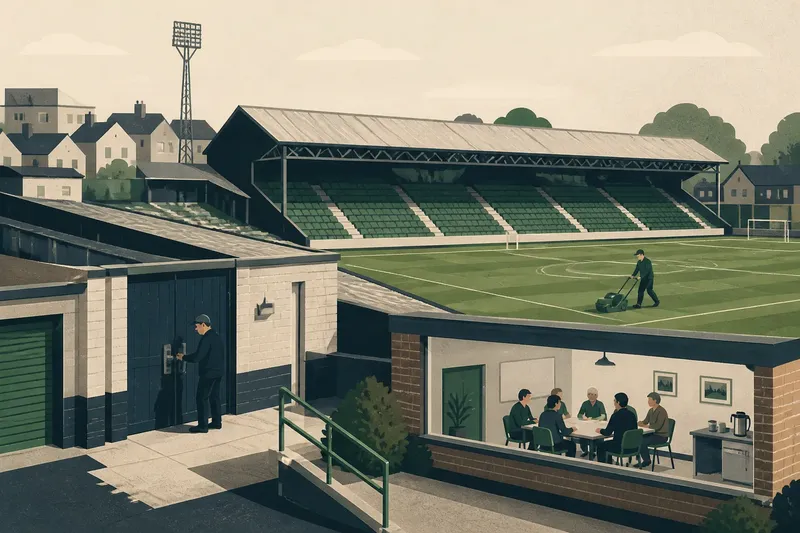
Empty stadium meaning is not hard to spot: a caretaker checks a door, a community group uses a meeting room, and the pitch crew tends the grass. A crowd transforms a ground, but it is not the only thing that gives the building a life.
Look beyond entrances and the paths people take through a venue. The quieter evidence lies in what is maintained, adapted and shared between fixtures.
Buildings make choices visible
A stand’s shape, the materials along its exterior and the way newer work meets older fabric record decisions about what to build and what to keep. These details are not a complete history, but they make change visible without a plaque explaining every argument.
A floodlight mast above nearby roofs or a distinctive roofline can also become part of the local skyline. The ground occupies a place in the neighbourhood even when there is no reason to enter it.
Upkeep is part of identity
Cleaning, painting and groundskeeping may happen out of sight, yet the work determines how a venue remains usable. A repaired handrail, fresh paint on a door and carefully tended turf each point to continuing attention rather than mere preservation.
Care does not mean making every surface look new. A ground can retain signs of age while repairing what people need to use safely and comfortably. The useful distinction is between character that is kept and disrepair that is simply left alone.
Shared rooms extend the calendar
Meeting rooms, cafés, gyms and offices can give a stadium a role on days without a fixture. They are not automatically useful because they exist: access, opening arrangements and facilities must suit the people expected to use them.
A room intended for a local meeting, for instance, needs a practical way in and enough ordinary support for that activity. If reaching it requires the whole venue to operate as though a match were under way, the arrangement may be more cumbersome than the room itself.
Quiet exposes the building
When a stand is busy, attention gathers around the pitch and the people nearby. In a quieter setting, the eye has more room for details such as lettering on a gate, the change in light beneath a roof or the contrast between concrete and brick.
This does not make silence better than a crowd. It lets the building register in a different way, just as the roar of a stand reveals things a still visit cannot.
What gives a stadium life between fixtures?
Can an empty stadium still matter?
Yes. Its place in the neighbourhood, its design and the work carried out there can matter whether or not a match is scheduled. A quiet ground remains a place shaped by decisions and daily care.
What makes a ground distinctive off the pitch?
Distinctive materials, a recognisable roofline and spaces used for activities beyond sport all contribute. Local memory matters too, though it need not depend on a full stand.
How can a club use a quiet day well?
It can consider which rooms suit a proposed activity, how people can reach them and what support they need. Meetings, training or local services may fit, provided the venue can accommodate them appropriately.
Does a quiet visit show everything?
No. It can reveal materials and signs of upkeep more clearly, but it cannot recreate the shared attention and collective sound of a fixture. Each setting offers a partial view.
A worked quiet-day decision
Imagine a club with a meeting room beside its main stand. For this invented situation, suppose the room has chairs, but visitors can reach it only through a corridor normally kept closed outside matchday operations. The club is considering a neighbourhood planning meeting.
First, the organiser checks whether the room is available and whether the corridor can be opened for the meeting. Next, they confirm that visitors can enter without crossing work areas or relying on matchday facilities. They then check that the room has seating and basic equipment suited to the meeting.
If the corridor can be opened safely and the room has what the group needs, the meeting can proceed with a clear route and a designated contact. If access depends on opening much of the stadium or the room lacks suitable facilities, the club can move the meeting to another venue rather than treating an awkward arrangement as community use.
Several clocks run together
A stadium follows more than the match calendar. Repairs and adaptations unfold slowly; training and meetings create recurring routines; the neighbourhood’s daily life carries on around the boundary.
Empty stadium meaning becomes clearer when you ask what the building enables between fixtures, who can make use of it and what care keeps it functioning. A full stand is one source of significance, not the only one.